
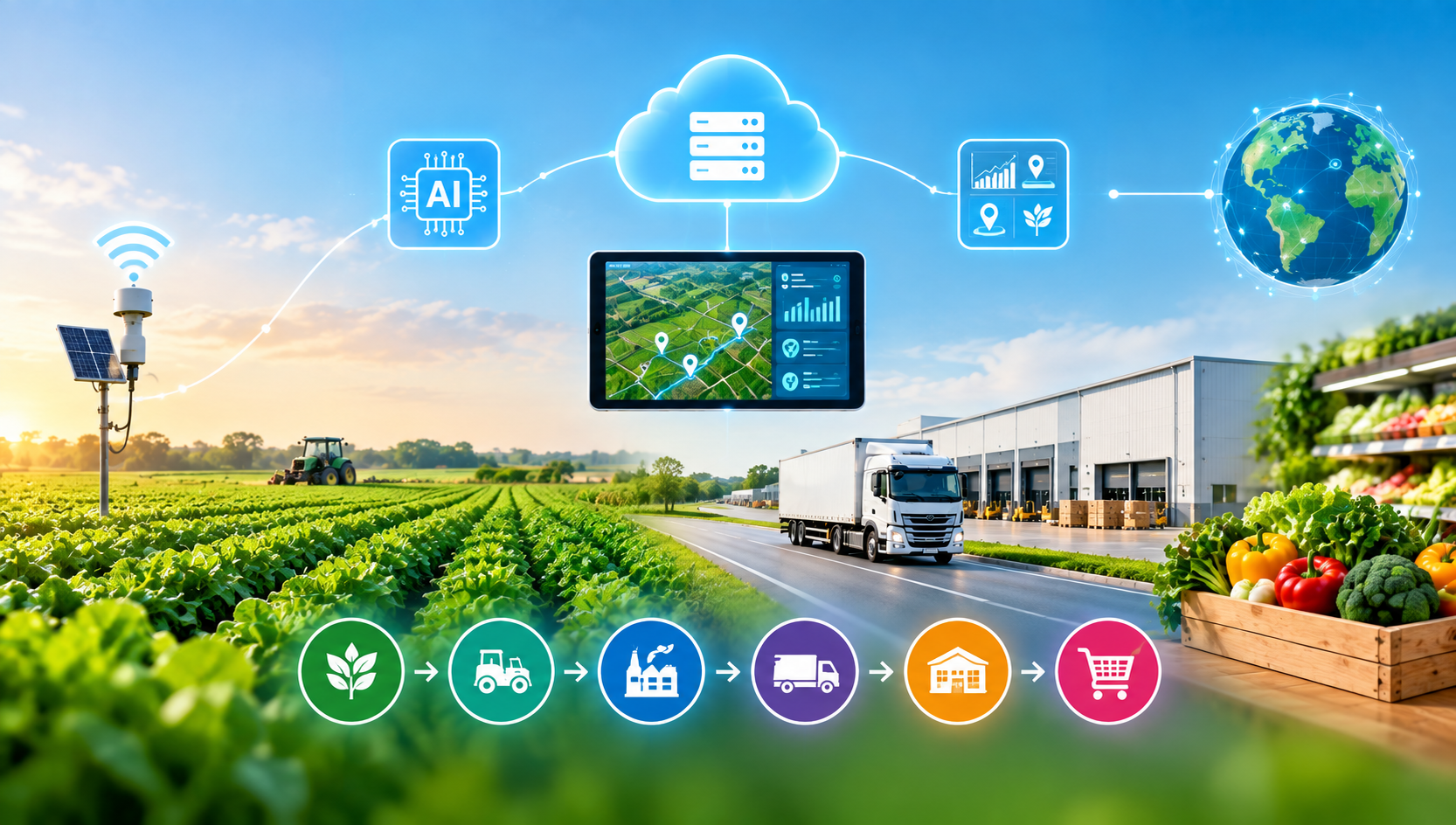
Agriculture is becoming increasingly connected, data-driven, and technology-enabled. From farms and processing facilities to distributors, retailers, and consumers, every stage of the agricultural supply chain generates valuable information. Managing this information effectively is essential for improving transparency, product quality, operational efficiency, and customer trust.
Agricultural Supply Chain Traceability is emerging as an important technology-driven approach for tracking agricultural products throughout their journey. By combining Artificial Intelligence (AI), cloud technology, IoT devices, data analytics, and digital platforms, businesses can gain greater visibility into agricultural supply chains and make faster, data-driven decisions.
What Is Agricultural Supply Chain Traceability?
Agricultural supply chain traceability refers to the ability to track and monitor agricultural products from their origin on the farm through processing, storage, transportation, distribution, and ultimately to the customer.
Traditional agricultural supply chains often involve multiple stakeholders and disconnected systems. This can make it difficult to identify where a product came from, how it was handled, whether quality standards were maintained, and where delays occurred.
A digital traceability system creates a connected flow of information across the supply chain. Data can include:
- Farm and crop information
- Harvest dates and locations
- Soil and weather conditions
- Processing information
- Storage conditions
- Transportation details
- Quality inspection records
- Distribution information
- Product destination
This creates a more transparent and connected agricultural ecosystem.
How AI Is Transforming Agricultural Supply Chain Traceability
AI can analyze large volumes of agricultural and supply chain data to identify patterns, predict potential problems, and support operational decisions.
For example, AI-powered systems can analyze historical crop data, weather conditions, transportation information, inventory levels, and market demand. These insights can help businesses anticipate supply chain disruptions and respond proactively.
AI can also support automated quality monitoring. Computer vision technologies can analyze images of fruits, vegetables, grains, and other agricultural products to identify visible defects, inconsistencies, or quality issues.
Instead of relying entirely on manual inspections, organizations can combine AI-based analysis with human quality-control processes to improve efficiency and consistency.
The Role of Cloud Technology in Agricultural Traceability
Cloud technology provides the infrastructure needed to collect, store, process, and access supply chain information from multiple locations.
Agricultural businesses can use cloud-based platforms to connect farmers, suppliers, processors, logistics providers, distributors, and retailers through a centralized digital environment.
With cloud technology, authorized stakeholders can access relevant information in real time without relying on isolated spreadsheets or disconnected databases.
Key advantages include:
- Centralized agricultural data
- Real-time information access
- Scalable infrastructure
- Easier collaboration
- Automated data synchronization
- Integration with business applications
- Improved data availability
Cloud platforms can also support organizations as their operations expand across farms, regions, warehouses, and distribution networks.
Improving Farm-to-Market Visibility
One of the biggest benefits of Agricultural Supply Chain Traceability is improved farm-to-market visibility.
A digital system can create a traceable record for agricultural products as they move through different stages. Businesses can use this information to understand product movement, identify bottlenecks, and improve coordination between stakeholders.
For example, if a shipment experiences a delay during transportation, supply chain managers can potentially identify the affected shipment, location, and stage of the process more quickly.
This level of visibility can help organizations improve logistics planning and reduce unnecessary delays.
AI-Powered Predictive Analytics for Agriculture
Predictive analytics is another important application of AI in agricultural supply chains.
AI models can process historical and real-time information to identify potential supply and demand trends. Businesses can use these insights to improve inventory planning, transportation scheduling, procurement, and production decisions.
For example, demand forecasting can help agricultural businesses estimate how much product may be required in a particular market. This can support better inventory management and potentially reduce unnecessary waste caused by overproduction or poor planning.
Similarly, predictive analytics can help identify potential supply chain disruptions by monitoring relevant operational data.
Improving Food Quality and Safety
Traceability can play an important role in quality management and food safety.
When agricultural products move through multiple stages, maintaining accurate records can help organizations understand where products originated and how they were handled.
If a quality issue is identified, digital traceability systems can help businesses locate relevant batches and investigate the stages involved.
AI can further support quality management by analyzing inspection data and identifying patterns that may require attention.
Together, AI and cloud technology can create a more connected approach to agricultural quality management.
Reducing Agricultural Supply Chain Waste
Agricultural products can be highly sensitive to time, temperature, storage conditions, and transportation delays. Inefficient supply chains can contribute to product losses and waste.
Cloud-connected systems can collect information from sensors and other digital devices to monitor relevant conditions. AI can analyze this information and identify unusual patterns or potential risks.
For example, temperature-monitoring data from storage or transportation environments can be analyzed to identify conditions that may affect product quality.
By improving visibility and enabling faster responses, technology can support more efficient agricultural supply chains.
Building a More Sustainable Agricultural Supply Chain
Technology can also contribute to sustainability initiatives across agriculture.
Organizations can use digital platforms to track resource usage, transportation activity, production information, and other operational metrics. This data can support sustainability reporting and help businesses identify areas where resources may be used more efficiently.
AI-powered analytics can help identify patterns in water usage, energy consumption, logistics, and agricultural production, supporting data-driven sustainability initiatives.
The Future of Agricultural Supply Chain Traceability
The future of Agricultural Supply Chain Traceability is likely to involve increasingly connected digital ecosystems. AI, cloud computing, IoT sensors, analytics platforms, and automation can work together to provide greater visibility across agricultural operations.
Instead of viewing farms, warehouses, logistics, and marketplaces as separate systems, businesses can connect them through integrated digital platforms.
This can create a more responsive supply chain where data flows between stakeholders and supports faster decision-making.
Conclusion
Agricultural Supply Chain Traceability is becoming an important component of modern agriculture and agribusiness. By combining AI and cloud technology, organizations can improve supply chain visibility, quality monitoring, forecasting, collaboration, and operational efficiency.
Cloud platforms provide the foundation for connecting agricultural data, while AI can transform that data into actionable insights. Together, these technologies can help agricultural businesses build more transparent, connected, and data-driven supply chains.
As agriculture continues its digital transformation, investing in AI-powered and cloud-enabled traceability solutions can help organizations better understand their operations and respond to the growing demands of modern agricultural markets.