
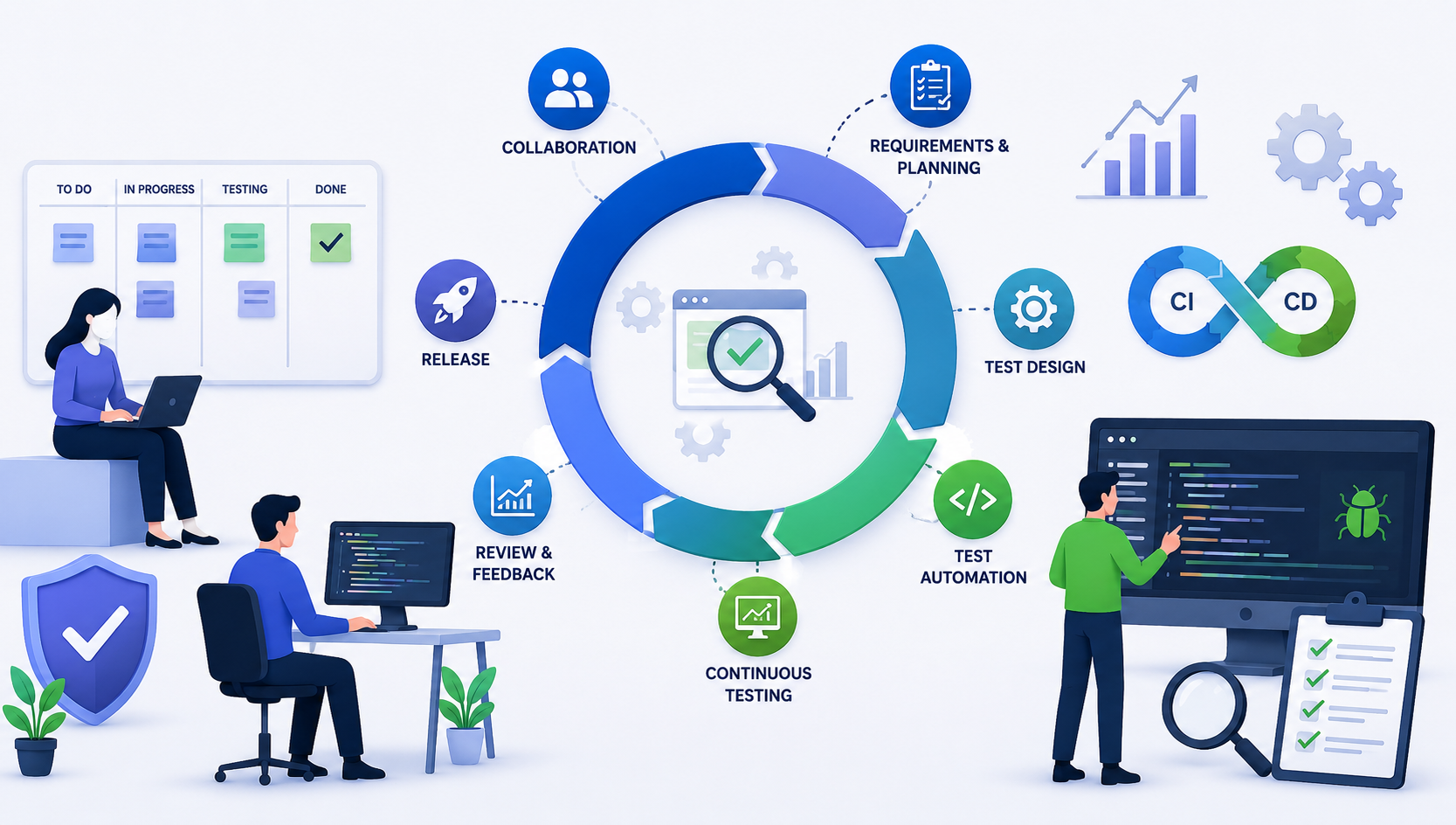
Agile software development focuses on delivering high-quality software through continuous development, collaboration, and rapid releases. In this environment, Quality Assurance in Agile Software Development plays an important role in identifying defects early, improving application performance, and ensuring that every release meets business and user expectations. Unlike traditional testing approaches, Agile QA is integrated throughout the software development lifecycle.
1. Involve QA Teams from the Beginning
One of the most effective Agile QA practices is involving quality assurance professionals from the planning stage. QA teams can review requirements, identify potential risks, define acceptance criteria, and prepare testing strategies before development begins. Early involvement helps prevent misunderstandings and reduces the cost of fixing defects later. Quality Assurance in Agile Software Development
2. Adopt Continuous Testing
Continuous testing allows teams to test software throughout the development process rather than waiting until the end of a project. Functional, regression, integration, and performance testing can be performed during each sprint. This approach helps development teams detect problems quickly and maintain consistent software quality.
3. Use Test Automation Strategically
Automated testing is essential for Agile projects that require frequent releases. Automation can handle repetitive test cases, regression testing, and integration testing efficiently. By combining automated tests with manual and exploratory testing, organizations can improve test coverage while allowing QA professionals to focus on complex scenarios.
4. Encourage Collaboration Between Teams
Successful Agile QA requires close collaboration between developers, testers, product owners, and business stakeholders. Regular sprint meetings, reviews, and discussions help teams understand requirements and resolve issues quickly. A shared responsibility for quality creates better communication and more reliable software.
5. Prioritize Risk-Based Testing
Agile teams often work with limited time, making it important to prioritize testing activities. Risk-based testing focuses on critical features, security-sensitive functions, high-traffic areas, and business-critical workflows. This ensures that the most important parts of an application receive adequate testing attention.
6. Integrate QA with CI/CD
Integrating QA processes with Continuous Integration and Continuous Delivery (CI/CD) pipelines enables automated testing whenever code changes are introduced. This helps identify defects before they reach production and supports faster, safer software releases.
Conclusion
Following effective quality assurance practices in Agile software development helps businesses deliver reliable, secure, and user-friendly applications. Continuous testing, automation, collaboration, risk-based testing, and CI/CD integration can create a strong QA framework that supports faster development without compromising quality.